
The Sustainability Equation: Why Mark Carney's Immigration Math Ignores the City's Scream

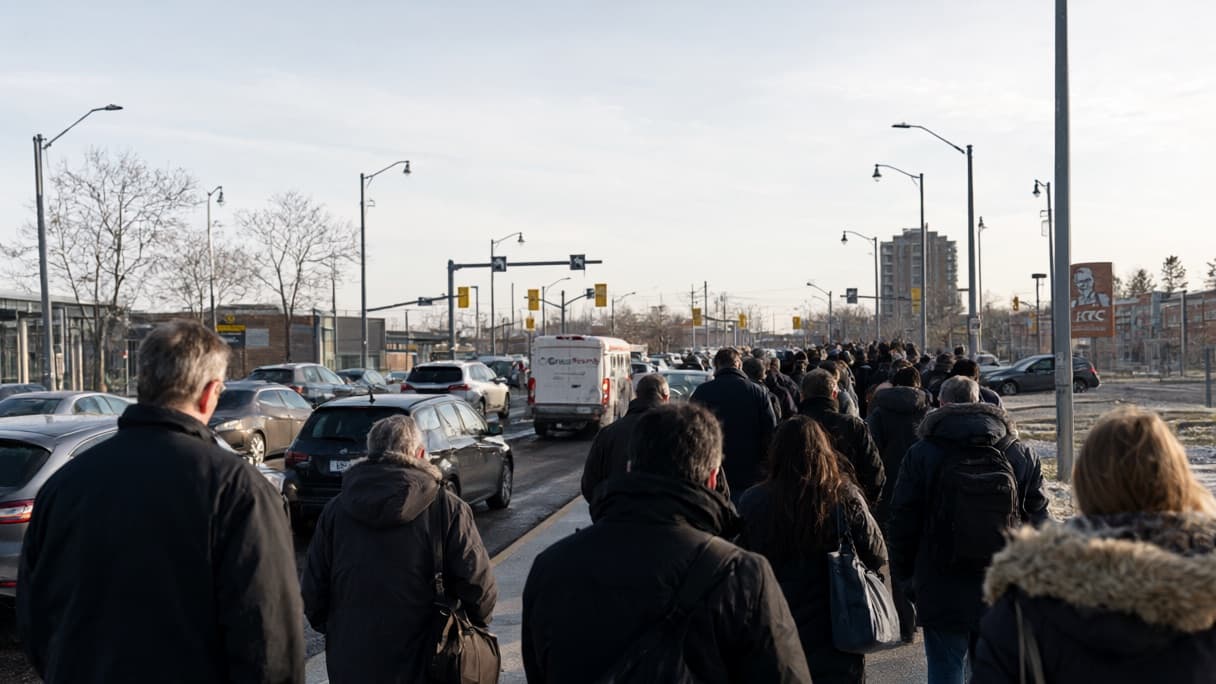
AI-generated image · Bay Street Wire
Prime Minister Mark Carney calls the new immigration levels plan 'sustainable,' but as the federal government treats human dreams like a budget line item, the infrastructure of our cities is reaching a breaking point.
### The Calculus of Growth
In the sterile halls of Ottawa, the dream of a new life in Canada is being reduced to a mathematical equation. As CBC News first reported, Budget 2026 reveals a federal plan to grant permanent and temporary residency to more than a million people next year.
Prime Minister Mark Carney insists this is a "sustainable" move. He claims the government has "taken back control of immigration" by slashing the numbers of asylum seekers by 68 per cent, temporary foreign workers by 57 per cent, and international students by 71 per cent since 2024. But there is a profound disconnect between the sustainability of a spreadsheet and the sustainability of a sidewalk.
### The Permanent Resident Surge
Under the new plan, the government intends to grant permanent residency to 380,000 people annually for the next three years. However, CBC News reports that one-time streams will push next year's new permanent residents to nearly 660,000.
This surge includes granting permanent residency to 200,000 temporary residents already working in Canada. Half will be processed through Provincial Nominee Program and Express Entry streams, while the other half are based on family reunification and humanitarian grounds, including approximately 19,000 people from Ukraine and nearly 32,000 from Hong Kong.
### The Capacity Crisis
Conservative Leader Pierre Poilievre, speaking in Brampton, Ont., argued that Canada cannot absorb these numbers, stating that youth are "desperate" for homes and jobs.
Data from Statistics Canada shows the 380,000 permanent resident intake represents roughly 0.9 per cent of the population—a figure that rises to about 1.5 per cent when the temporary boost is included. These figures are only slightly higher than Canada's annual birth rates (372,000 in 2025 and 366,000 in 2024) and just above death rates (327,000 in 2023 and 326,000 in 2024).
The government's commitment of $302 million over four years starting in 2027-28 to assist this transition is a gesture, but it does little to address the physical infrastructure of the cities that must house them.
### The Illusion of Control
By focusing on reductions in asylum seekers and students, Carney claims victory. Yet, the plan still targets over a million total residents next year, including a "one-time initiative" from a previous budget adding nearly 80,000 more permanent residents in 2027.
If the federal government continues to define "sustainability" solely through population percentages, they will miss the most important metric: the breaking point of the Canadian city. Until mathematical dreams translate into bricks and mortar, "sustainable" remains a political fiction.