
The Hollow Symbolism of Queen's Park: Why U.S. Steel in Our Soil is a Policy Failure

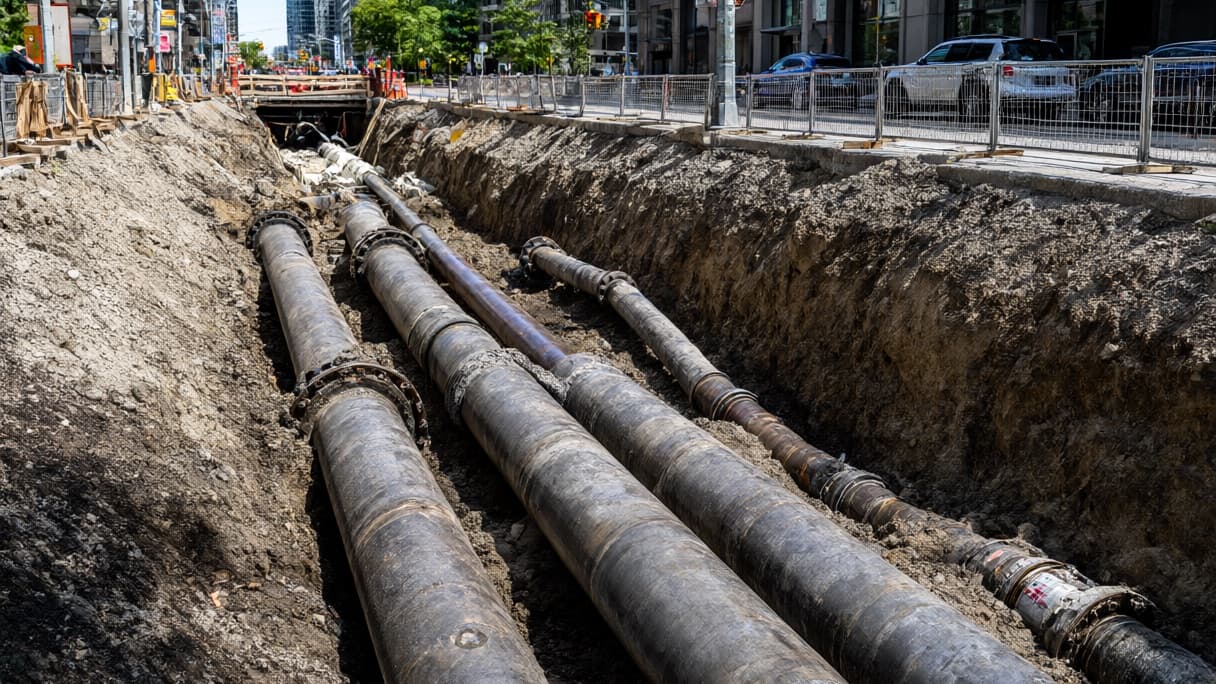
AI-generated image · Bay Street Wire
Opinion: The installation of American-made water mains in the heart of Toronto is more than a procurement glitch—it is a damning indictment of the government's failure to protect domestic industry during a trade war.
There is a profound irony currently unfolding in the soil just steps away from Ontario's provincial legislature. As members of the Legislative Assembly debate the future of our province, the ground beneath Queen's Park Crescent E. is being filled with steel pipes manufactured in the United States.
As reported by CBC Toronto, the City of Toronto awarded a $17.7-million contract to North York-based Gio Crete Construction Ltd. to replace water mains in the downtown core. In executing this work, Gio Crete sourced specialized pipes from a contractor in West Virginia. This procurement occurred even as U.S. President Donald Trump doubled tariffs on Canadian steel to 50 per cent in an attempt to cripple local suppliers.
The City of Toronto claims these specialized pipes simply aren't made in Canada, but this admission exposes a cavernous hole in our domestic industrial strategy. We cannot claim to be committed to local supply chains while our most critical infrastructure projects remain dependent on the whims of U.S. manufacturers.
The human cost of this dependency is being paid in real-time. CBC Toronto reports that in March 2026, hundreds of workers at Algoma Steel in Sault Ste. Marie faced layoffs, and more recently, Stelco in Hamilton laid off more than 100 workers—despite government demands for a jobs-saving plan.
Ron Wells, president of United Steel Workers 1005 in Hamilton, argues that during this trade war, governments must prioritize the use of public funds to safeguard Canadian employment. Wells is correct; relying on the hope that a foreign president will suddenly become benevolent is not a trade policy; it is a prayer.
The excuses from City Hall are equally hollow. Sabrina Dipietro, the city’s senior manager of purchasing client services, told CBC Toronto that the tender closed before the city's March 2025 tariff response plan was in place and that the contract's value would have left it open to international bidders regardless.
This reveals a systemic inertia. As Riley Brockington, president of the Association of Municipalities of Ontario, put it, it is "hard sometimes to turn [the] giant ship." But when that ship is sailing straight into a trade war, "hard" is no longer an acceptable excuse. Councillor-elect Mike Layton, who will represent the area, rightly questioned why tax dollars are being moved out of the country rather than cycled back into the Canadian economy.
If the provincial government is serious about protecting Ontario's industrial heartland, it must actively foster an environment where these "specialized" products are actually manufactured here. Every American pipe sunk into the ground at Queen's Park is a monument to our own industrial inadequacy.