
The Hollow Crown: Zverev's Ascent to No. 1 is a Statistical Triumph and a Psychological Failure

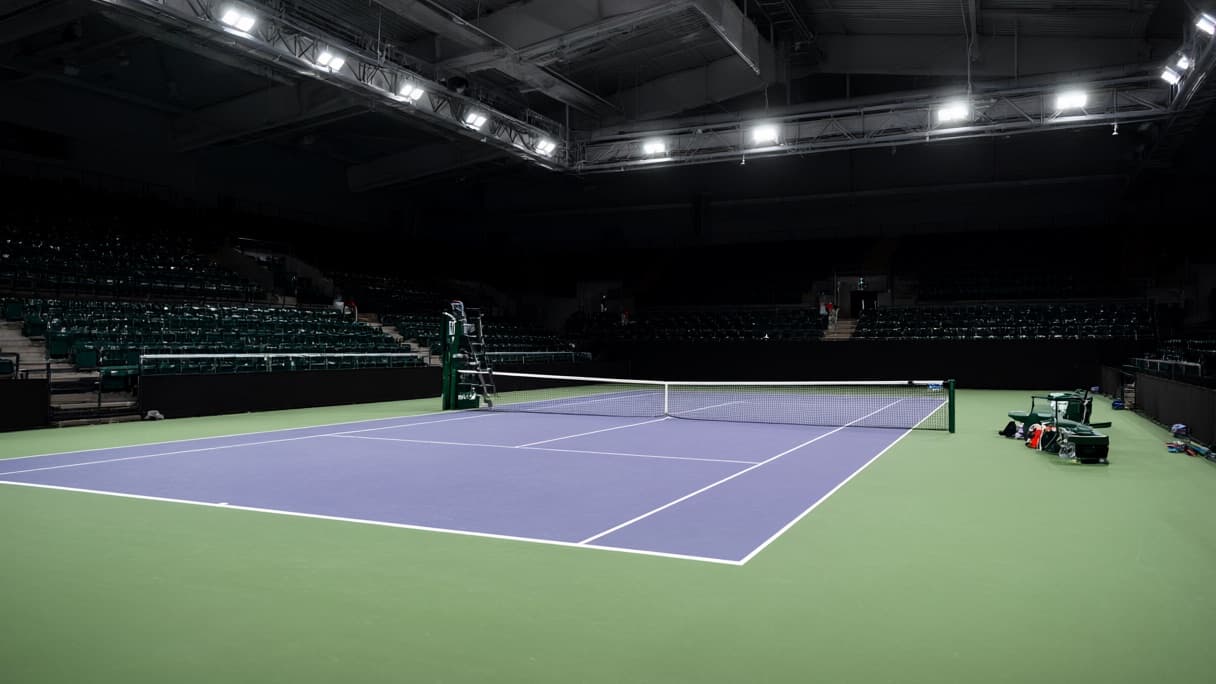
AI-generated image · Bay Street Wire
Opinion: While the rankings finally reflect Alexander Zverev's dominance on paper, his collapse against Lorenzo Musetti reveals a fragile mental state unfit for the tour's leadership.
The record books will show that Alexander Zverev reached the summit of men's tennis on Monday. After a season defined by his first two career Grand Slam titles at the U.S. Open and the French Open, the 29-year-old German has finally secured the world No. 1 ranking. On a purely mathematical basis, this is a formality; the points are there, the trophies are in the cabinet, and the ascent is justified.
However, as any student of the game knows, there is a vast chasm between being the highest-ranked player on a spreadsheet and being the undisputed leader of the ATP Tour. If the goal of the No. 1 player is to project an aura of invincibility and psychological fortitude, Zverev's debut as the world's top-ranked player was a catastrophe.
In his first outing as No. 1 at the Paris Masters, Zverev suffered a humbling second-round defeat to Lorenzo Musetti. As reported by Sportsnet, the Italian dismantled the world No. 1 in a 7-6 (5), 6-2 victory. The scoreline is one thing, but the nature of the collapse is what should alarm Zverev's supporters. This was not a match decided by a few unlucky bounces or a superior tactical plan from Musetti; it was a performance that Zverev himself admitted was "bad."
In the wake of the loss, Zverev did not mince words, describing the outing as "maybe one of the worst in the last couple of months." What makes this failure particularly glaring is that the conditions were tailor-made for Zverev's game. The German noted that the court in Nanterre was "very, very fast," asserting that this was exactly the kind of court it should be—a surface that typically favors his aggressive stroke play. Yet, instead of dominating, Zverev looked "out of sorts" throughout the contest.
When you examine the statistics provided by Sportsnet, the gap in execution is stark. Musetti, the mercurial Italian, played with a precision that Zverev simply could not match, recording 29 winners to Zverev's 25. More tellingly, Musetti committed only 12 unforced errors, while Zverev surrendered 21. To be the world No. 1 is to be the benchmark of consistency and composure. To lose in such a one-sided fashion—capped off by a Musetti ace—suggests that Zverev is still playing a game of catch-up with his own mental toughness.
But the most concerning aspect of Zverev's ascent isn't the loss to Musetti; it is the agitation that seems to be consuming him. In his post-match comments cited by Sportsnet, Zverev sounded less like a confident champion and more like a man besieged by perceived slights. While acknowledging that the No. 1 status is a dream for every player, Zverev expressed frustration over a lack of credit, claiming he feels like the "only world No. 1 in tennis history that has to explain why it's okay" for him to hold the top spot.
This perceived need for validation is the antithesis of the psychological armor required to lead the tour. The greats—the Novak Djokovics and Carlos Alcarazes of the world—do not seek permission to be No. 1; they impose their will on the game until the ranking becomes an afterthought. Zverev, conversely, seems preoccupied with the optics of his achievement. By stating that he finds it "difficult" to explain why he deserves the ranking, he inadvertently reveals a lack of inner certainty.
If Zverev wants to be more than a statistical curiosity, he must stop looking for external validation and start finding the internal stability that allows a player to survive the pressures of the top spot. The Paris Masters served as a brutal reminder that rankings are earned through points, but respect is earned through resilience.
As the tour moves toward the season-ending ATP Finals in Turin, the landscape remains volatile. We see veterans like Novak Djokovic fighting for a spot in the finals, and young stars like Carlos Alcaraz continuing to clash with the likes of Alex Michelsen. We see the volatility of the draw, where seeded players like Frances Tiafoe can waste four match points in a loss to Quentin Halys, or fourth-seeded Daniil Medvedev can fall to Ignacio Buse.
In this environment of chaos and high stakes, the world No. 1 should be the eye of the storm. Instead, Zverev appears to be caught in the wind. He has the trophies and he has the rank, but until he can handle a fast court and a mercurial opponent without crumbling—and until he can stop worrying about whether the world thinks he deserves his spot—his tenure at the top will feel like a hollow victory. The crown is on his head, but Zverev has yet to prove he has the strength to carry its weight.